


Beneath changing forms,
something continues.
When people visit Japan for the first time, they often notice small things before the famous landmarks.
Clean streets.
Patient lines.
Quiet trains where phone calls go unanswered.
These are not attractions.
They are habits.
Japan’s beauty does not rely on spectacle alone. Beneath its visible forms lies a quieter sensibility — harmony with nature, restraint in expression, and awareness of others.
To experience something authentic is not to witness a performance. It is to notice what persists.
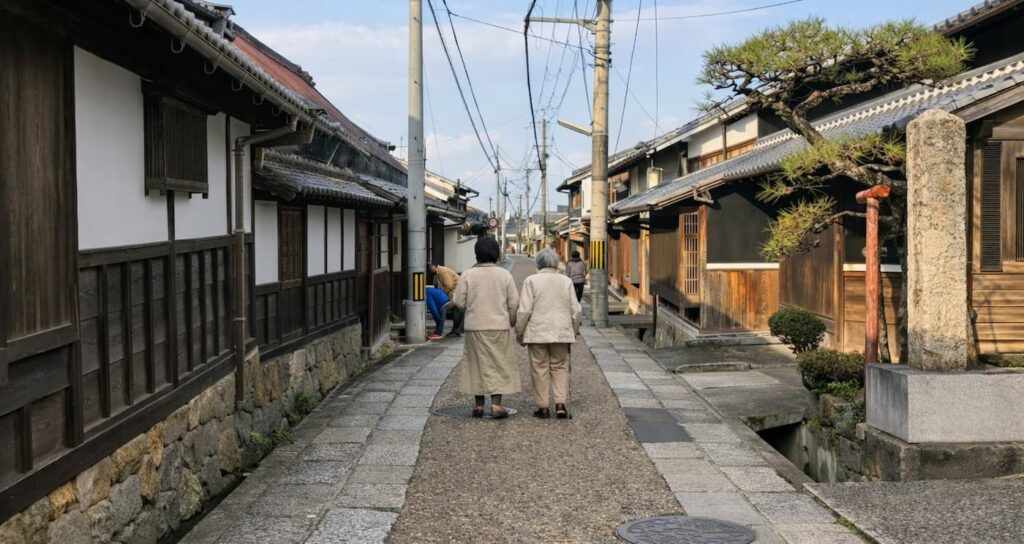
Beyond What You See
Cleanliness may be explained by efficiency.
Order may be attributed to rules.
Yet something deeper shapes behavior.
Shared spaces are treated with care.
Atmosphere matters.
One’s actions are understood to affect others.
What appears disciplined is often grounded in coexistence.
A Culture Shaped through Time
In Kyoto, elegance was refined into gesture and restraint.
From the 12th century onward, the warrior class governed Japan for centuries. Living with the constant awareness of mortality, samurai cultivated presence — a focus on how to live each moment fully.
Within this context, Zen found resonance. Its emphasis on discipline and impermanence aligned naturally with warrior life.
Over time, its influence extended beyond that world.
The intensity of Noh, the measured gestures of the tea ceremony, the spatial clarity of traditional architecture — each reflects a sensibility shaped by Zen.
Later, during the Edo period, stability depended not only on law, but on shared responsibility.
Foreign ideas entered Japan across these eras. They were adapted rather than copied, woven into an existing worldview.
What emerged was layered rather than replaced.
Where the Foundations were Laid
Before formal institutions, there existed a way of seeing.
Mountains were not only landscape.
Rivers were not only resource.
Stones and trees were approached with awareness.
From this grew an understanding of coexistence.
In the 6th century, in what is now known as Asuka, structures formed. New philosophies entered. Systems took shape.
Yet what endured was quieter.
A preference for balance.
Sensitivity to shared space.
An instinct to preserve harmony — even in crowded places.
These foundations are not displayed.
They are sensed.
Continuity in Changing Forms
Forms shift.
Noh and Kabuki.
Tea ceremony.
Manga and anime.
Different expressions.
A continuous sensibility.
Authenticity does not reside in costume.
It resides in continuity.
Discovering It for Yourself
In Asuka, early layers remain visible.
In Takatori, rhythm and shared responsibility still shape daily life.
In Yoshino, nature and spirituality exist side by side.
These places do not explain.
They allow space.
What you notice there will be your own.